
After the Business Plan: The First Operational Steps Into Self-Employment
A convincing business plan forms the basis for a successful start in self-employment. It helps you structure business ideas, prepare financing, and assess opportunities and risks realistically. After the business plan is finished, however, the decisive phase begins: practical implementation. Only the first operational steps create the conditions for a business idea to become a functioning company.
In the first weeks after founding the business, it becomes clear how important a structured approach is. Many founders initially concentrate on individual tasks and lose sight of the big picture. Clear prioritization ensures that all organizational, legal, and commercial requirements are met in time.

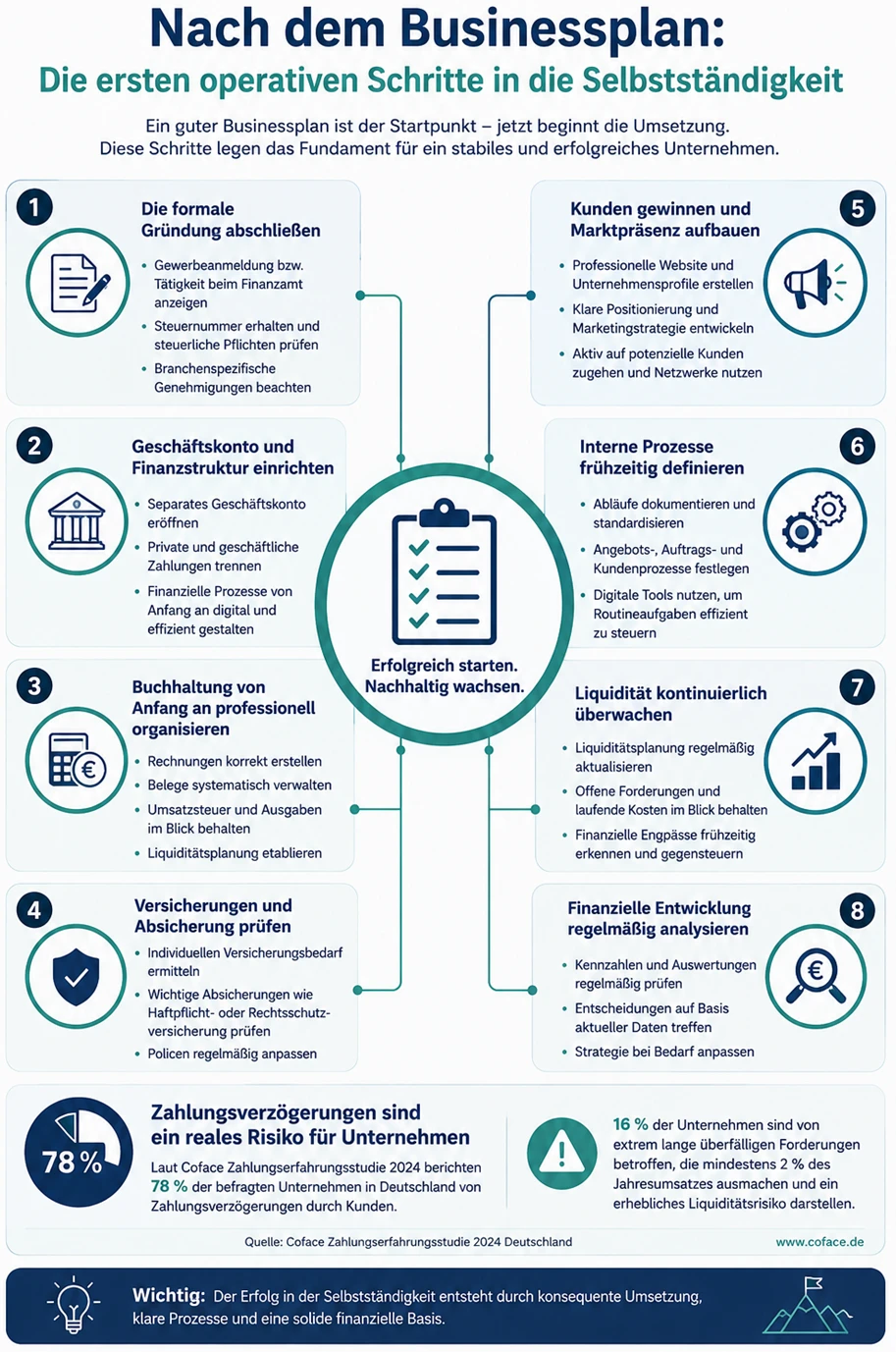
Complete the Formal Founding
After planning, the legal implementation comes first. Depending on the legal form chosen, various registrations are required. Sole proprietors register their business with the responsible trade office (Gewerbeamt), while freelancers notify the tax office (Finanzamt) of their activity directly.
In addition, tax registration takes place. The tax office assigns a tax number and checks which tax obligations will apply in the future. It is advisable even at this stage to analyze the requirements for value-added tax, income tax, or trade tax (Gewerbesteuer) precisely, so that later back payments or missed deadlines are avoided.
Industry-specific permits also deserve particular attention. In many fields there are licensing or proof requirements that must be met before business activities begin.
Set Up a Business Account and Financial Structure
Professional financial organization makes everyday business much easier. That is why setting up a separate business account is one of the most important tasks after founding. Separating private and business payments creates transparency and simplifies accounting.
Founders should determine how invoices are created, receipts are archived, and incoming payments are monitored. Digital solutions help make financial processes efficient from the start. Suitable software reduces administrative effort and enables better control over liquidity and ongoing costs.
Especially in the early phase, reliable business software proves to be valuable support.
Organize Accounting Professionally From the Start
Many founders underestimate the effort involved in ongoing bookkeeping. Yet clean accounting forms the basis for business decisions and tax obligations.
Clear processes should be in place right from the beginning for the following areas:
- Invoicing
- Receipt management
- Expense management
- VAT documentation
- Liquidity planning
The earlier these processes are established, the lower the later administrative effort. At the same time, an up-to-date data basis improves control over the company’s financial development.
Review Insurance and Protection
The business plan often contains initial considerations on risk provision. After founding, the concrete implementation follows. The actual insurance needs depend on the industry, company size, and field of activity.
For many self-employed people, professional liability insurance, business liability insurance, or legal expenses insurance are among the relevant coverages. In certain industries, additional policies may be required, for example for technical equipment, vehicles, or business assets.
It turns out that effective insurance protection only exists if all relevant risks are taken into account and existing policies are regularly adapted to the company’s development.
Win Customers and Build Market Presence
Even the best business model achieves no success without customers. That is why active marketing of your offering begins immediately after founding. Basic marketing measures should already be prepared before the official launch.
These include a professional website, meaningful company profiles in relevant networks, and clear positioning in the market. It also makes sense to start first sales activities and make targeted use of existing contacts.
A consistent external presentation strengthens credibility and builds trust with potential customers. Particularly in the first months, high visibility helps generate the first orders more quickly.
Define Internal Processes Early
As the order situation grows, so do organizational requirements. That is why founders benefit when internal workflows are documented and standardized already in an early phase of the company.
Clear processes create transparency, reduce sources of error, and make later expansion of the company easier. This concerns, among other things, quotation processes, order processing, customer communication, and document management.
Digital workflows help manage routine tasks efficiently and keep administrative burdens permanently low. This leaves more time for sales, customer care, and strategic development.
Monitor Liquidity Continuously
A positive order situation does not automatically guarantee financial stability. Young companies in particular often come under pressure when incoming payments are delayed or ongoing costs are underestimated.
That is why liquidity planning should be updated regularly. Outstanding receivables, recurring expenses, and planned investments must remain traceable at all times. An early overview of financial bottlenecks allows timely countermeasures and increases planning certainty.
The transition from the business plan to operational management largely decides the development of a young company. Structured organization, professional administrative processes, and consistent financial planning create the conditions for the business idea to become established on the market in the long term.
Current figures from the credit insurer Coface also underline the importance of consistent liquidity planning. In the 2024 payment experience study (Zahlungserfahrungsstudie), 78 percent of the surveyed companies in Germany reported being affected by payment delays. At the same time, 16 percent reported long overdue receivables amounting to at least two percent of annual revenue, which represent a considerable liquidity risk. Ongoing monitoring of outstanding receivables and planned expenses helps to identify financial bottlenecks early and to initiate suitable countermeasures.

Decide to have your business plan created, and do everything right from the start
Get competent partners on an equal footing. Benefit from experience, expertise, clarity, and orientation. Walk the path to a successful start-up together with us. We create the business plan for you.